

Build on Land You Own
Every industry eventually hits its sovereignty moment. It's the point where the people doing the work look up and realize someone else owns the thing that makes the work valuable — and that they signed it away without noticing. Banking had it with the payment networks. Local news had it with the social platforms. Construction is having it right now, in the fine print of AI subscriptions, and most of the industry hasn't looked up yet.
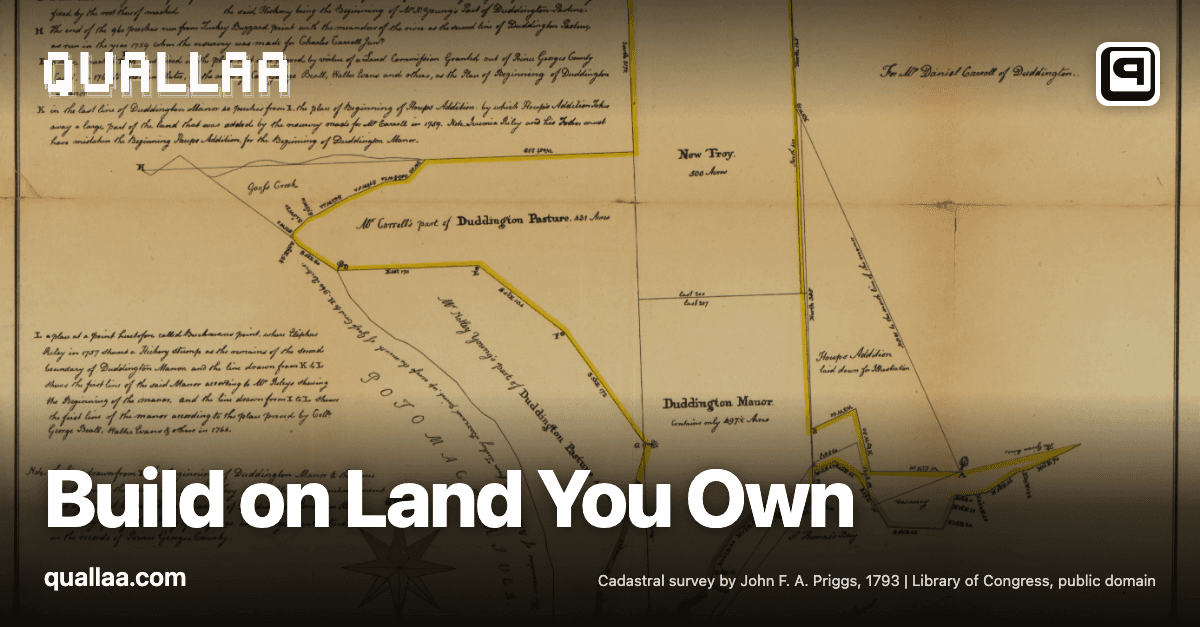
The survey at the top of this page is from 1793 — John Priggs laying out Charles Carroll Jr.'s tracts in what would become central Washington, D.C. A cadastral map does exactly one job, and it does it permanently: it fixes whose land is whose, so that everything built on a parcel from that day forward accrues to the name in the margin. Two centuries later, that's still the only question that decides whether something you build is an asset or a liability. The contractors signing AI deals in 2026 are pouring foundations without checking the survey.
The debate everyone thinks construction is having
The conventional take goes like this: the AI tools work now, the early adopters are pulling ahead, and the only real question is how fast the laggards catch up.
Half right. The tools do work. Thirty-eight percent of contractors now report measurable impact from AI on their business, up from seventeen a year ago — one of the fastest adoption curves the industry has ever posted. Estimating systems are hitting 85 to 90 percent accuracy in minutes instead of half a day. Pilot firms are cutting admin hours by a third. With a 500,000-worker shortage going into 2026, the productivity case is settled and the skeptics lost.
But adoption was never going to be the real fight. It never is. The real fight is over who owns the data that makes the tools work — and on that question, the industry is losing badly without knowing the score.
What the platforms figured out before you did
Here's the thing the construction-management platforms understood early, and most of their customers still don't: the AI is not the asset. The data is.
A model that's read ten thousand real projects — how actual firms price, sequence, and recover when a job goes sideways — is worth something no public dataset can touch. And the only people sitting on ten thousand real projects are the contractors. So the platforms did the rational thing. They wrote the right to train on your work into the terms of service of tools you already pay for. Your schedules, your costs, your RFIs, your change orders — Engineering News-Record and the construction-law blogs spent this spring documenting how "standard licensing language that grants broad usage rights" quietly turns all of it into training feedstock.
This isn't a conspiracy and the platforms aren't villains. Compounding data advantage is simply the best business in software: accumulate enough high-quality data and the product gets stickier, the moat gets deeper, and the customer gets more dependent every quarter. It's the same playbook the payment networks ran, the same one the ad platforms ran. It works. It's just a terrible deal for whoever's on the other side of the clause.
Whatever you affix to the land
There's a doctrine in property law older than any of us: quicquid plantatur solo, solo cedit — whatever is affixed to the soil belongs to the soil. Build a barn on land you don't own and the barn isn't yours. It became a fixture. It belongs to whoever holds the dirt.
Every contractor understands this in their bones. You'd never pour a foundation on a lot you were renting month-to-month and call the building an asset. Software quietly imported the same doctrine, and almost nobody noticed. Run your operation on someone else's platform and your data is affixed to their land. You can stop paying. You can export a CSV. But the pattern you taught their model — the part with the real value — became a fixture the moment it trained. It belongs to the soil now, and the soil isn't yours.
Who wins, who's exposed, who's hedging
Read this the way you'd read any leverage contest, because that's what it is.
The platforms win. Every job their customers run sharpens a model they own. Then the sharper model gets sold back next quarter as a premium feature — and sold to the GC bidding against you on the next project, and the one after that. The contractor supplied the raw material; the platform keeps the compounding asset.
The high-volume contractor is the most exposed. The more projects you run, the more valuable the signal you're handing over, and the more directly you're funding a tool that will be pointed at your own margin. You are not a customer in that arrangement. You're an unpaid supplier building equity in someone else's company, collecting one dividend: the privilege of renting back a commoditized version of your own expertise.
The sophisticated buyers are already hedging. The firms with real volume have started reading the clause. Construction lawyers are publishing "AI clause audits" for EPC contracts. The GSA's proposed AI procurement rule goes all the way and bars vendors from training on government project data at all. The people who understand leverage are quietly pulling their data off the table. Most of the industry hasn't noticed the table exists.
The tenant and the owner
Strip away the technology and there are only two positions in this market.
You can be a tenant — running your operation on someone else's platform, generating value that's affixed to their land, building a model you'll rent back at a markup. Convenient, fast to set up, and structurally a slow transfer of your hardest-won knowledge to a company that may sell it to your competitor.
Or you can be an owner — and this is the part the building industry already understands better than the software industry does. You build on land you own. The system runs on accounts in your name: the database is yours, the cloud infrastructure is yours, the relationship with the model provider is yours. The AI works on your jobs, and your jobs never quietly become training feedstock, because there's no third party holding the land underneath your data.
That distinction is the whole game, and it's why an owned build is even possible: the major model providers will rent you the engine without taking the land. Anthropic, for one, does not use data submitted through its API to train its models. You rent the capability. You keep the data. Concretely, an owned system means the cloud accounts are provisioned in the customer's name, the estimates and change orders live in storage the customer controls, the model is called over that data rather than fed it, and leaving is a migration of your own stuff — not a hostage negotiation with a vendor over an export.
It's more work than clicking "subscribe." It's also the difference between an asset and a liability dressed up as a convenience.
Why you can't wait this one out
The reason this can't be managed later isn't legal. It's physical.
Mess is cheap to make and expensive to clean up — and some messes can't be cleaned up at all. You can cancel a platform. You cannot reach into a trained model and pull your change orders back out. Once your pricing patterns are in the weights, they're in the weights. There's no clawback, no undo, no "actually, please forget how we bid mechanical work." Giving the data away took one click and lasts forever; recovering it is impossible.
That asymmetry is the whole reason the decision has to be made up front. By the time you've read the clause and lawyered up, the training already happened on last year's jobs. The only place to intervene is before you affix your work to someone else's land — which means this is one of those calls you make with understanding, not remediation. Measure twice. The cut you can't un-make is the one worth thinking hardest about. Your data is that cut.
The principle
Use AI. The adoption numbers are right, the productivity is real, and the labor math demands it. That debate is over and you should act like it.
But know what you're standing on while you do. If the value you generate compounds into a model you'll rent back at a markup, you're improving someone else's lot. If it compounds into a system you own, on accounts in your name, on land you hold the title to, you're building an asset. Same AI, same capability — entirely different deal, decided by the one question nobody asks until it's too late.
Whose land is this built on?
Build on land you own.
Want to build something like this?
Quallaa is an AI agency. We build custom AI-native systems for teams in the building industry — ground-up, on your own stack. The first conversation is free.
Related Articles
Knowing Which Screw to Turn
John Jumper shared a 2024 Nobel for AlphaFold, then left DeepMind for Anthropic — and his parting message is that the machine still doesn't understand anything. He splits what AI does into three: predict, control, understand. The first two are settled and getting cheaper. The third stays human, and it's where the value is. Why capability was never the bottleneck — and why understanding doesn't get cheaper as the models improve.
Boaty McBoatface Is Now an AI Problem
In 2016, the public named a ship Boaty McBoatface and the institution panicked. The same pattern is playing out in AI deployment right now. Lock it down or let it rip -- or build the trust layer.
Speed to Lead Statistics in 2026: How Fast Should You Respond to Leads?
Responding in under 5 minutes makes you 100x more likely to connect. Here are the speed-to-lead statistics that matter — and what they mean for your business.