

Knowing Which Screw to Turn
The debate about AI that everyone thinks they're having is about capability — can it do the thing yet, and when. The real one is about understanding. And the person who just settled the capability question in biology is the one telling you so.
John Jumper shared a 2024 Nobel Prize in Chemistry for AlphaFold, the system that predicts a protein's three-dimensional shape from its raw sequence — cracking a problem that had stood for half a century. Two hundred million structures, each predicted in minutes, work that used to cost a biologist a year of labor and six figures of equipment time. In June 2026 he left Google DeepMind for Anthropic. A man with that résumé has earned the right to oversell what he built. He does the opposite.
In a recent interview, Jumper draws a line most people shipping AI products never bother to draw: there are three different things a system can do, and they are not the same — predict, control, understand. A machine can predict what will happen. It can control — make the number come out 17. But understanding, he says, "it doesn't do the act of understanding for us." That part still belongs to a person.
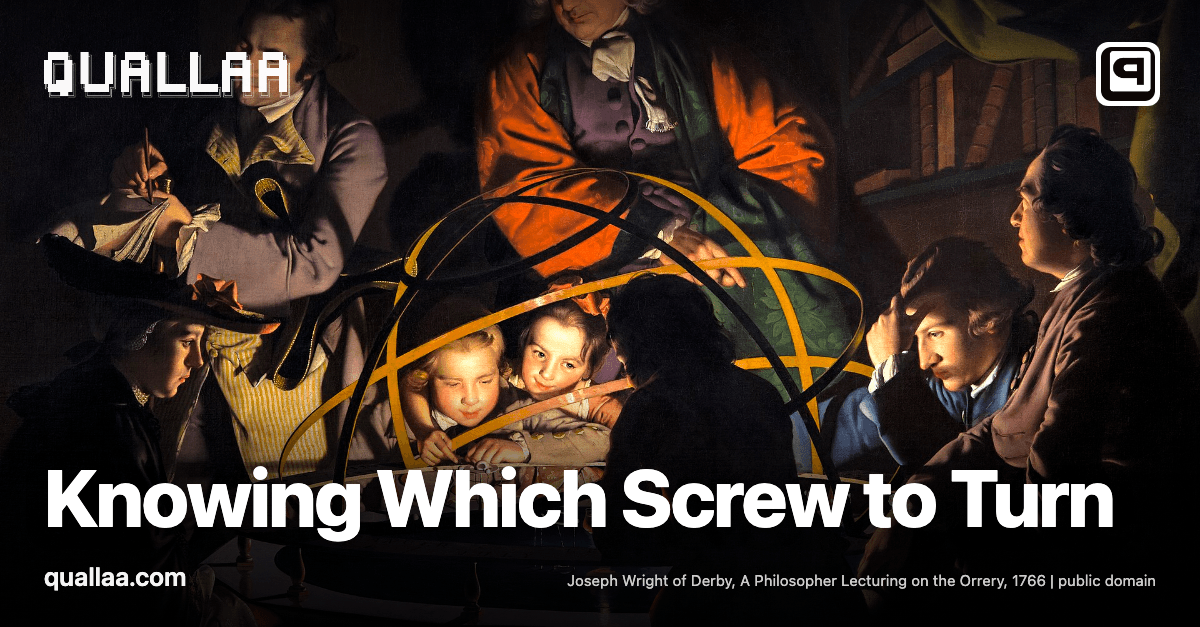
Joseph Wright of Derby painted the difference in 1766. A Philosopher Lecturing on the Orrery shows a small crowd leaning into the lamplight around a brass orrery — a machine that predicts the heavens. Turn the crank and its planets wheel through their orbits, accurate to the eye, centuries before anyone could integrate the equations of motion. The instrument is genuinely useful and completely empty of understanding. The understanding is in the faces around it: in Kepler and Newton, in the people who could compress the sky onto an index card and hand it to someone else. The orrery predicts. It does not know why. Wright's whole composition puts the light on the humans, not the brass.
The $10,000 Question
Jumper tells an old joke to make it land. A critical machine in a factory breaks down. They call a technician. He looks it over, walks to one screw, gives it a quarter turn, and the line roars back to life. He hands them a bill for $10,000. They're outraged — you turned one screw. He itemizes it: turning the screw, one dollar. Knowing which screw to turn, nine thousand nine hundred and ninety-nine.
That's the shape of value in every AI-native system we build. The model will turn any screw you point it at, instantly, for almost nothing. Pointing at the right one is the entire job. Jumper is blunt about why AlphaFold is useful precisely because it's narrow: "We are not a model of the entire cell. We are a predictor of this experiment." It does one measurable thing extraordinarily well and refuses to claim the rest. The understanding of what to do with the prediction — which mutation matters, which drug to design, which question is even worth asking — stays human.
Why the Bottleneck Doesn't Move
Here's the part that should change how you plan. Most industries treat AI adoption as a waiting game: the capability isn't good enough yet, so we wait for the next model, and the value will arrive when the capability does.
It won't — not by itself. Capability gives you predict and control. It hands you the orrery. But the value was never in the brass; it was in knowing which screw to turn, and that's a property of the person, not the machine. Worse, that bottleneck doesn't get cheaper as the models improve. It arguably gets harder, because a more capable system executes a poorly-understood request faster and more convincingly — carrying it further before anyone notices it was the wrong screw.
In the building industry, where a misquoted bid or a mis-scoped change order can't be un-sent, that asymmetry is the whole game. The mess is cheap to make and expensive — sometimes impossible — to clean up. A faster orrery doesn't help you there. Understanding does.
What We Actually Sell
We build AI-native systems for an industry that runs on judgment — design-build firms, contractors, building-products manufacturers. The temptation in that work is to sell the orrery: here is a system that predicts, that automates, that does the thing. The honest version is harder and worth more. The system is the easy part. What we're really doing is making sure the person operating it understands it well enough to point it at the right screw — and building the guardrails that hold when an irreversible action is one quarter-turn away.
The man who built the most capable scientific AI on earth is, on his way to Anthropic, telling anyone who'll listen that the machine doesn't understand anything. He's right. That's not a limitation to engineer away. It's where the work is.
The Principle
The model turns the screw for a dollar. Knowing which screw to turn is still worth ten thousand — and it always will be, because it was never the machine's to know.
Want to build something like this?
Quallaa is an AI agency. We build custom AI-native systems for teams in the building industry — ground-up, on your own stack. The first conversation is free.
Related Articles
Build on Land You Own
AI adoption in construction just jumped to 38% of contractors reporting measurable impact. But the fight has moved from whether AI works to who owns the data that makes it work — your schedules, costs, RFIs, and change orders, quietly training a vendor's model. The AI-native alternative: build on accounts you own, where your data is an input, never a training set.
Boaty McBoatface Is Now an AI Problem
In 2016, the public named a ship Boaty McBoatface and the institution panicked. The same pattern is playing out in AI deployment right now. Lock it down or let it rip -- or build the trust layer.
Speed to Lead Statistics in 2026: How Fast Should You Respond to Leads?
Responding in under 5 minutes makes you 100x more likely to connect. Here are the speed-to-lead statistics that matter — and what they mean for your business.