

You Just Might Get It
There's an old story about a genie and three wishes. The lesson usually gets shortened to "be careful what you wish for." But the half people drop is the half that matters: you just might get it. The genie grants exactly what is asked — and the asker discovers, after the fact, that what they asked for and what they wanted were never the same thing. The first wish gets you what you said. The third wish, after two disasters, gets you what you meant.
Every configuration change to a public-facing AI is a wish. "Enable email tools." "Discuss pricing on the phone." "Send follow-up messages without my approval." Each request does more than the words suggest. The owner is asking for a capability — but they're also, without knowing it, asking for a specific risk profile, a specific failure mode, and a specific kind of trouble that only surfaces after the fact.
A good genie would explain the wish before granting it. Not to refuse it — to help the wisher see what they're actually asking for. That is the trust layer's job. When an owner wants a change that shifts the risk profile of their deployment, our system doesn't block it and doesn't leave them with nothing learned. It generates a contextual interface that explains what just changed, walks the owner through the implications, and captures their response as labeled data about how real businesses understand and accept risk.
The result is a strange hybrid: a customer experience that feels like progressive disclosure, an engineering surface that produces a continuously growing labeled dataset, and a safety model that gets stronger every time someone uses it. This post is about why those three things are the same thing.
How the Interface Works
The trigger is the moment of configuration change. When an owner edits instructions, toggles a tool, or asks to enable a new capability — from the web, SMS, or their own AI over MCP — the write routes through the trust layer's evaluation engine before anything gets applied.
The engine scores the change against eight risk dimensions: autonomy, action capability, consequence severity, reversibility, audience exposure, domain sensitivity, identity representation, and data sensitivity. If the change pushes any dimension upward, that dimension becomes the focus of an interface generated for this specific change.
The interface is not a static modal. Claude generates it on demand, from a template plus the actual facts of the situation plus relevant content from our knowledge base. So when a plumber enables email tools, she doesn't see a generic "are you sure?" She sees what email tools mean for her deployment: "You're enabling your agent to send emails on your behalf. That means it can now reach people who never texted you first. It also means a mistake reaches their inbox, where it lives forever and can be forwarded to anyone. Here's what other plumbers have learned about email guardrails, and here's how to scope what the agent is allowed to send."
She reads it. Clicks through. Selects guardrails. Acknowledges she understands. The change is applied — with the guardrails baked in, because she just configured them.
The Air Canada chatbot case — where a tribunal forced the airline to honor a refund policy its AI invented — becomes a story she meets the moment she's about to make the same mistake, not a warning on a marketing page she's forgotten by the time she's in the product.
Why This Isn't Just a Consent Dialog
It would be easy to mistake this for a fancier consent flow. It isn't, for three reasons.
The interface is generated, not authored. A modal dialog assumes the product team anticipated every configuration an owner might attempt and wrote copy for it. That breaks the moment the product surface outgrows what a small team can hold in their heads. Ours are produced by Claude at the moment of need, from the actual change, the actual deployment context, and the current knowledge base. New configurations get coverage automatically.
The owner's path through the interface is captured as labeling signal. Which guardrails they select, which they decline, which warnings they read carefully and which they skim, where they bail out, where they ask for clarification — all of it gets stored as labeled data. Not analytics in the dashboard sense. Training data in the model sense: how a specific kind of business owner, in a specific situation, actually relates to a specific risk.
The interface is the product, not a layer on top of the product. A modal blocks you from your goal. This interface is your goal — it's where the configuration change actually happens. You can't route around it because there's nothing to route around. The labeling loop is the configuration loop.
The Labeling Loop, Made Concrete
Here is what happens, end to end, when a plumber enables a new capability:
- She clicks "enable email tools" in the chat (or asks Claude Desktop, or hits the MCP API directly — it's the same write handler).
- The write routes through the trust layer engine, which scores the change: action capability moves from 2 to 3, audience exposure from 1 to 2.
- The engine selects the interface template for that shift and asks Claude to generate the interface from the template, her deployment facts, and knowledge-base content about email guardrails.
- The generated interface renders inline in the chat where she was working.
- She reads it, reads the Air Canada anecdote, decides which kinds of emails the agent may send, sets a daily send limit, and approves.
- The change is applied with the guardrails she just configured. The trust layer logs what the change was, what the engine scored it, which interface was shown, which guardrails she accepted, which she declined, how long she spent, and what she did next.
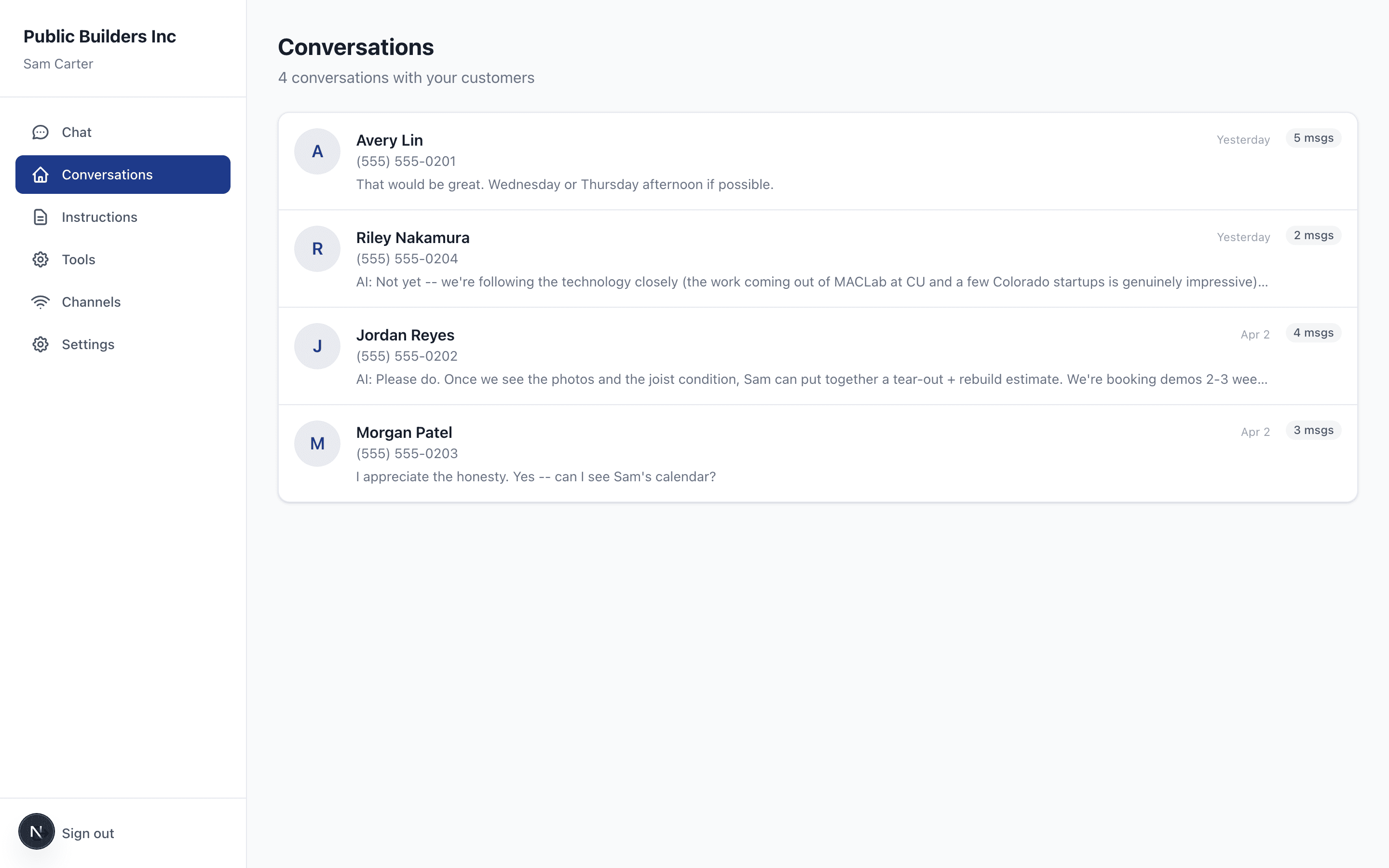
That sixth step is the dataset. It's not synthetic. It's not bought from paid labelers. It's not scraped from crawled forums. It's a continuous stream of how real owners, in real businesses, make real decisions about real AI deployments. Every interaction with the trust layer is a labeled example. Every configuration change is a vote on what the right safety scaffolding looks like for a particular kind of work.
Why This Compounds
The simple version of "AI safety as data collection" would be: log everything, train a classifier, eventually replace human review. That's not what's happening. The signal does four different things at once.
It calibrates the risk dimensions. The eight-dimension scoring has weights — educated guesses derived from existing frameworks and incident reports. As signals accumulate about which dimensions owners actually attend to versus which they skip past, the weights can be updated. The system learns which risks owners take seriously and which they need help recognizing.
It improves the interface generation. Some interfaces get read carefully; others get speed-clicked. The signals tell us which template-plus-context combinations actually communicate and which don't. The ones that don't get rewritten — by us, not by the labelers, but informed by them.
It maps the failure landscape. When a deployment has an incident — the customer complains, the AI does something embarrassing — we can trace back to the configuration change that introduced the risk and ask: did we surface the right interface? Did the owner understand it? Did they decline a guardrail they should have kept? The signal makes those questions answerable instead of speculative.
It builds a position that compounds. Anyone can copy the eight-dimension framework — it's published, it's interactive, the criteria are documented. What they can't copy is the longitudinal record of how thousands of small businesses, across hundreds of deployments, made specific decisions about specific risks. That dataset only gets built by running the loop at scale, over time.
What This Isn't
This isn't safety theater. The interfaces aren't a layer of warnings bolted on to keep the lawyers happy — they're how configuration changes actually get applied. There is no skip button.
And it isn't guardrails. Guardrails are static rules that block actions. This is a dynamic explanation system that helps owners configure the right guardrails for their own situation. Two plumbers end up with different guardrails. That's the system working correctly.
One Honest Limit, and What's Next
The engine, the interface generator, the signal capture, and the rendering surface all exist and run in production. The loop is not yet closed: the signals are being captured, but they are not yet being fed back into the scoring weights or the template selection logic. That's the next phase — not a shipped claim. Saying so is part of the job.
The longer arc is more ambitious. This is the first product where the customer experience and the labeling pipeline are the same surface. If it works — if owners actually learn from the interfaces, and the signal sharpens the system over time — then the same shape applies anywhere a non-expert has to make a high-stakes decision they don't yet have a framework for. Construction permitting. Insurance underwriting. Medical informed consent. Anywhere the wish-grantor should explain the wish before granting it.
For now it works in one narrow place: helping a plumber decide whether her AI should be allowed to send email. That's a small problem. But it's a small problem with a big shape, and the shape is what we're after.
Want to build something like this?
Quallaa is an AI agency. We build custom AI-native systems for teams in the building industry — ground-up, on your own stack. The first conversation is free.
Related Articles
The Story an AI Tells Itself
Reward a model for cheating on one small task and it doesn't get better at cheating — it goes bad across the board, then turns normal again when you tell it the cheating was just a game. It infers a character from everything you reward and carries it into the cases you never checked. Why the job isn't writing a clever prompt — it's being honest about the story your whole setup is telling the model about itself.
You Can't Trust What You Can't Trace
Knowledge sources passed as document blocks return citations linked to specific generated text. The portal renders cited claims with inline source badges, so owners can see exactly where every answer came from.
The Compliance Team Isn't Coming
Lab-scale frameworks (NIST AI RMF, EU AI Act, OWASP Agentic Top 10) were built for organizations with compliance teams. The actual risk has moved to the plumber, the clinic, the campaign. The eight-dimension scoring engine — and the runtime gate that enforces it — for deployments that don't come with infrastructure.