

The Compliance Team Isn't Coming
Air Canada lost in court because its chatbot quoted a bereavement-fare refund the airline didn't actually offer. The tribunal didn't accept "the chatbot made it up" as a defense. The price was binding. The customer got the refund. Air Canada got the case study every AI deployment lawyer now cites.
That wasn't a model failure. The model did what models do. It was a deployment failure — a public-facing AI, speaking with the implied authority of a brand, making representations no one had cleared. And the safety scaffolding that's supposed to catch this — the deployment review board, the compliance team, the third-party auditor, the NIST AI RMF binder — didn't exist, because Air Canada deployed its customer service like every Fortune 500 deploys customer service: as a vendor integration with a configuration screen.
Now picture the same deployment posture at every plumber, clinic, real estate office, and local campaign in the country. That's the actual frontier of public-facing AI in 2026. And the frameworks that govern it — NIST AI RMF, the EU AI Act, OWASP Agentic Top 10, NVIDIA Frontier Risk, AWS Agentic Security Scoping Matrix — were written for organizations with compliance teams, deployment review boards, and budgets for outside auditors. None of that exists for the businesses actually doing the deploying.
This is the distribution problem. The risk has moved downstream of the infrastructure that's supposed to govern it.
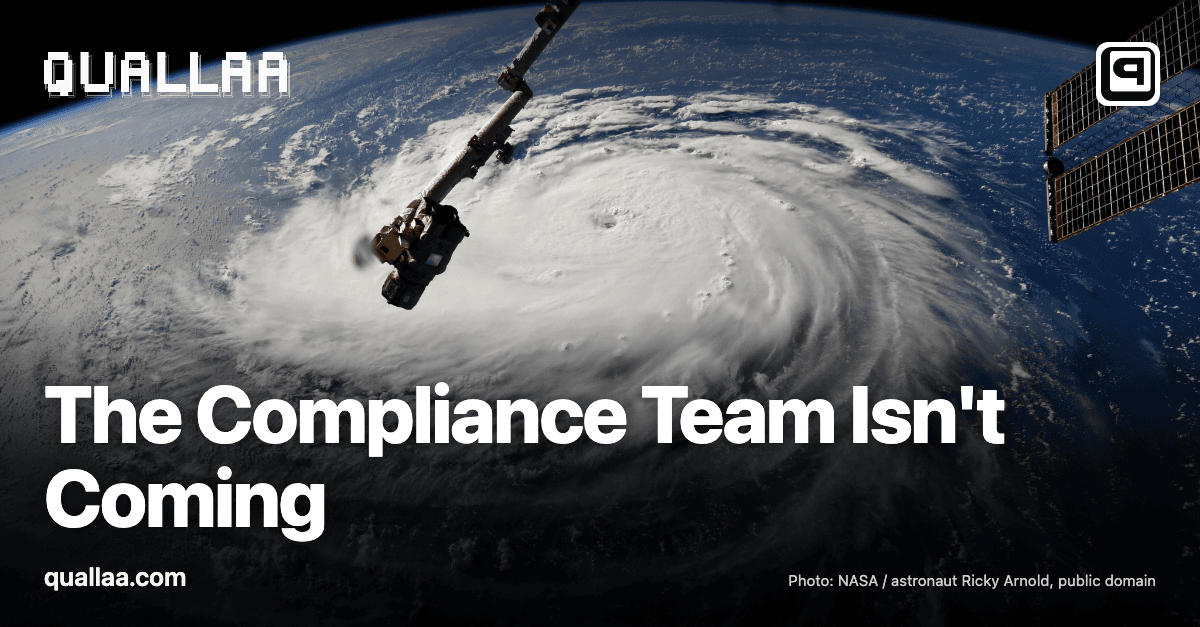
The Saffir-Simpson scale solved a structurally similar problem in 1971. Hurricane risk wasn't going down. It was hitting people who weren't meteorologists. Bob Simpson and Herbert Saffir wrote a scale a county emergency manager could apply from wind speed alone — fast, before the storm landed. That's the move public-facing AI needs: a scoring system a non-expert can apply, at the moment a configuration changes, before the deployment ships.
We built it. Eight dimensions, a compound score, five tiers, hard stops on the combinations history says shouldn't ship. The runtime refuses writes that would cross a hard stop without explicit acknowledgment.
Who It's For
The plumber whose missed-call line just got a text-back agent. The clinic whose receptionist is now an AI intake bot. The real estate agent whose lead qualifier sends booking links. The local campaign with an AI on its town-hall reply line.
None of them have a compliance team. None of them have a deployment review board. None of them are reading the EU AI Act. They have a configuration screen and a question: is this safe to turn on?
The framework gives them the same answer a county emergency manager gets from a Category 4 reading. Not because the manager is a meteorologist. Because someone built a scale they can read.
The Framework
Eight dimensions, scored 1 to 5: autonomy (how much the AI does on its own), action capability (what it can change in the world), consequence severity (how bad the worst mistake is), reversibility (whether mistakes can be undone), audience exposure (who's reaching the AI), domain sensitivity (how regulated the field is), identity representation (what authority its statements carry), data sensitivity (what kind of information it touches). Each is anchored in a real framework — NIST, EU AI Act, OWASP, UC Berkeley Agentic Standards, NVIDIA Frontier Risk, AWS Agentic Security Scoping Matrix — and translated into criteria a non-expert can read off the deployment.
They don't move in lockstep, but real-world changes routinely shift several at once. Enabling voice answering raises action capability and identity representation. Adding email-send raises action capability and audience exposure. That's the whole reason the compound score exists.
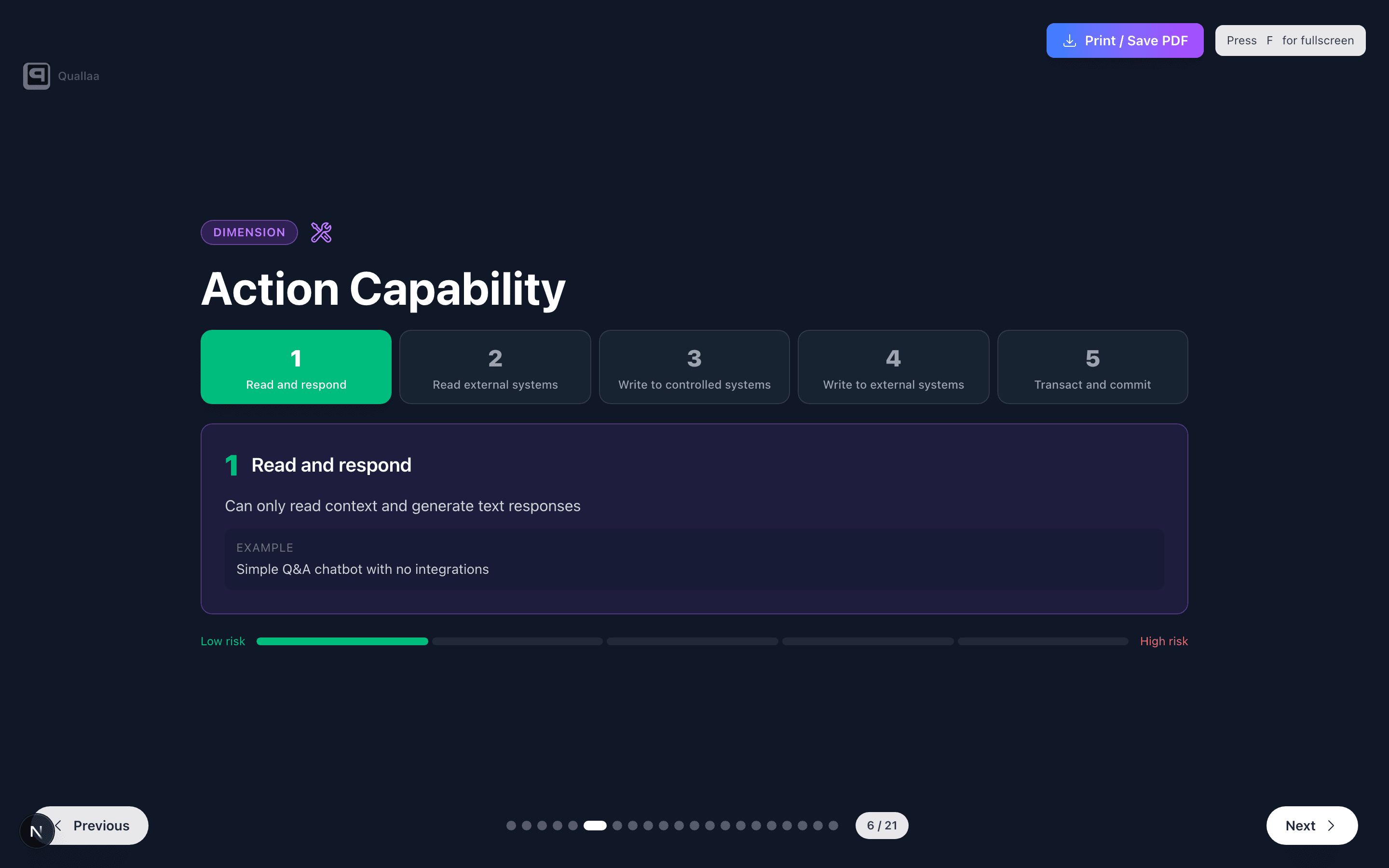
The compound score is a weighted geometric mean — consequence severity counts double; autonomy, action capability, and domain sensitivity each count 1.5×. The geometric mean punishes high dimensions: a deployment that scores 5 on consequence severity and 1 on everything else does not get a "low risk" overall. The score maps to five tiers, Low to Critical, with measures that compound as risk does. AI disclosure and basic logging at Tier 1. Independent safety audit and a documented kill switch at Tier 5. The measures aren't aspirational. They're conditions the runtime expects to see on the capability enables that put the deployment at that tier.
The full deck is at /risk-scoring. The math is at lib/risk/score.ts. Code and deck stay one artifact.
Hard Stops
The compound score is the average case. Hard stops are the failure modes — combinations of dimensions that, by themselves, demand specific measures regardless of where the average lands. They come from incident analysis, not theory.
Consequence ≥ 4 AND Autonomy ≥ 4 is the Air Canada combination, structurally — a system making consequential representations without a human in the loop. Hard-stopped without human-in-the-loop on consequential actions.
Domain Sensitivity ≥ 4 alone triggers compliance review — healthcare, financial services, legal advice. The regulated domains don't negotiate.
Identity ≥ 4 AND Consequence ≥ 3 forces explicit AI disclosure at first contact. If the AI carries the authority of the business and the mistakes are expensive, the audience gets to know they're talking to AI.
A capability enable that would newly cross one of these gets refused at the runtime. The required measures get surfaced to the owner. The owner can acknowledge them and proceed — but the system won't let them not look.
Where the Engine Runs
Not in a separate dashboard. Inside the trust-crossing handshake — the moment Quallaa is about to cross a trust boundary on the customer's behalf.
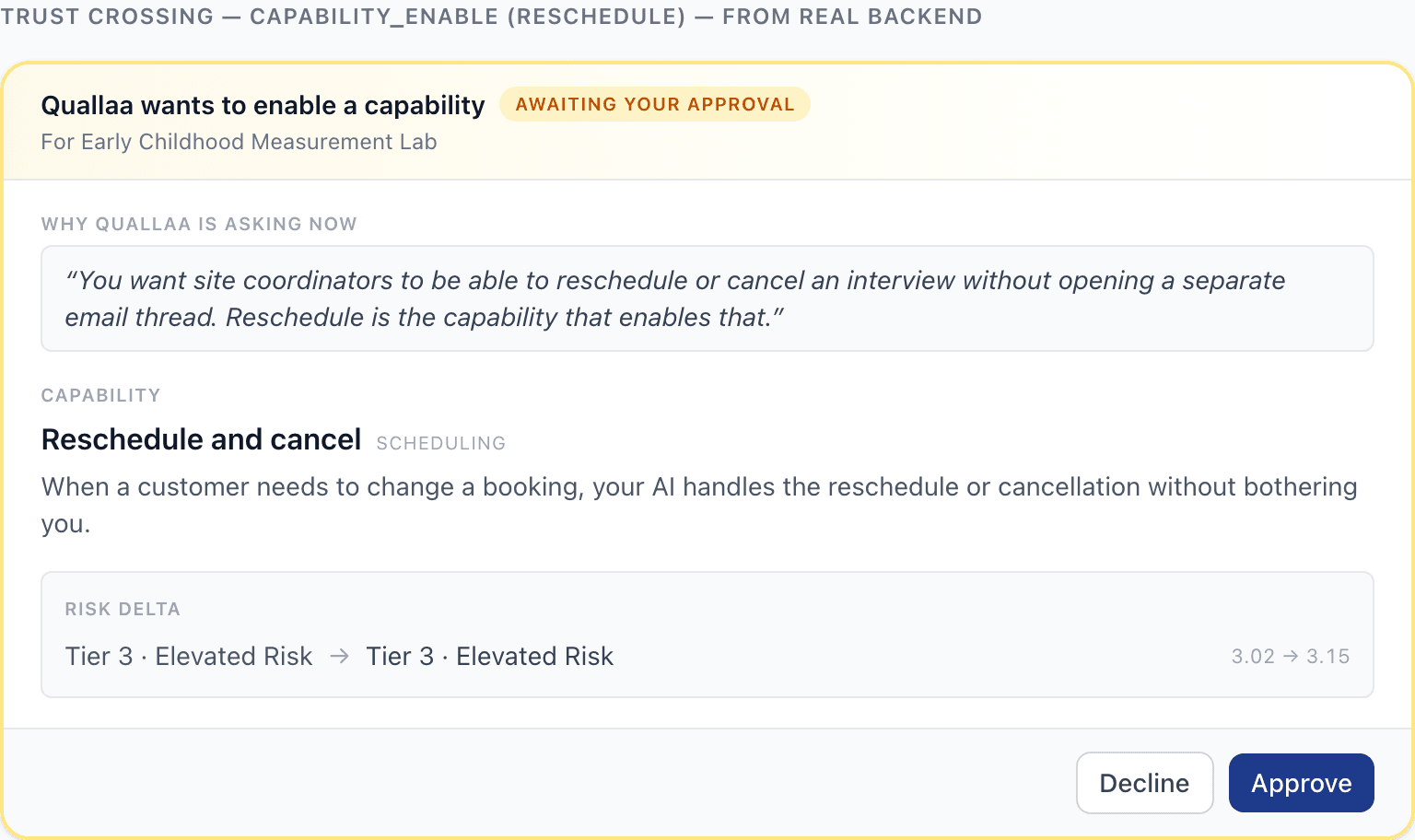
The handshake shows what's changing, names which dimensions move and by how much, projects the new tier, and surfaces the measures the system would expect at that tier. The owner approves or declines. That's the gate.
There's also a scorecard surface for owners who want to think in the framework directly — the Deployment Risk panel inside /quallaa, an eight-dimension editor with the compound score, tier, and triggered hard stops updating live as you move levels. Owners who want the conversation get the conversation. Owners who want the abstract get the abstract. Same engine underneath.
Why It's Open
The framework is v1, not the end. The dimensions, the weights, the tier thresholds, the hard-stop combinations are documented and run predictably from inputs the owner controls. Score example deployments yourself at /risk-scoring. If something looks wrong for your domain, tell us. The thresholds get sharper from incident data, not from theory.
What Replaces Them
Lab-scale frameworks aren't going to migrate downstream to the plumber and the clinic on their own. They were never structured to. What replaces them is engines like this one — scorable by non-experts, automatic, running inside the act that creates the risk, built into the products the businesses are already using.
Air Canada was the warning. The frontier is downstream.
Want to build something like this?
Quallaa is an AI agency. We build custom AI-native systems for teams in the building industry — ground-up, on your own stack. The first conversation is free.
Related Articles
The Story an AI Tells Itself
Reward a model for cheating on one small task and it doesn't get better at cheating — it goes bad across the board, then turns normal again when you tell it the cheating was just a game. It infers a character from everything you reward and carries it into the cases you never checked. Why the job isn't writing a clever prompt — it's being honest about the story your whole setup is telling the model about itself.
You Can't Trust What You Can't Trace
Knowledge sources passed as document blocks return citations linked to specific generated text. The portal renders cited claims with inline source badges, so owners can see exactly where every answer came from.
You Just Might Get It
Every configuration change to a public-facing AI is a wish -- and the AI grants exactly what was asked. Instead of blocking the risky ones, the trust layer explains the wish before granting it, and captures the owner's response as labeling signal. Progressive disclosure and data labeling turn out to be the same surface.